

 by Austin LeClear
on November 26, 2026
TLDR: Most AI-written Google Ads fail because the prompts are generic. People paste something like “write 15 headlines for my carpet cleaning business” into ChatGPT or Claude, and they get 15 variations of the same sentence. The AI is not the problem. The framework is. At Grow My Ads, we manage millions a month in ad spend across more than 100 clients, and AI now writes most of our Responsive Search Ads. One recent test built a full campaign with AI under our framework and generated a $1,000 sale the next day. The framework has five parts: intent match, USPs, trust, offer plus CTA, and a theme test. When those five parts are baked into the headlines, the ad reads like it was written for one specific searcher instead of hundreds. This guide walks through the full framework and three ways to use it with AI, from a prompt you can paste into ChatGPT today to the AI tool we built internally.
We have more than 100 clients, and we manage millions a month in ad spend. Today, AI writes most of our ads, and those ads convert.
That sentence is not the flex it sounds like. It is the opposite of what most people see when they try to use AI for Google Ads copy.
Most AI-written ads are bland, repetitive, and ignored. The headlines say the same thing fifteen slightly different ways. The call to action is missing. Nothing in the ad tells the searcher why this business is different from the other five results on the page.
That is not an AI problem. It is a framework problem.
Prefer video? Check out How We Use AI to Write High-Converting Google Ads on YouTube:
Still with us? Good, let’s dive in.
Why Most AI-Written Google Ads Fail
The failure mode is almost always the same. Someone opens ChatGPT, Claude, or Gemini and types one line.
“Write 15 headlines for my carpet cleaning business.”
The AI does exactly what it was asked to do. It writes 15 headlines. The problem is that fifteen headlines without a framework is just fifteen ways of saying “carpet cleaning in your city.” The headlines overlap, Google rotates them randomly, and nothing in the ad gives a searcher a reason to click.
This matters more than most advertisers realise. Better ads have a higher click-through rate. A higher click-through rate usually earns a better quality score. A better quality score usually lowers your CPCs. So the ad copy is not just a creative exercise. It is a direct lever on what every click costs you.
The fix is not writing better prompts in the moment. The fix is giving the AI a framework it can follow every time.
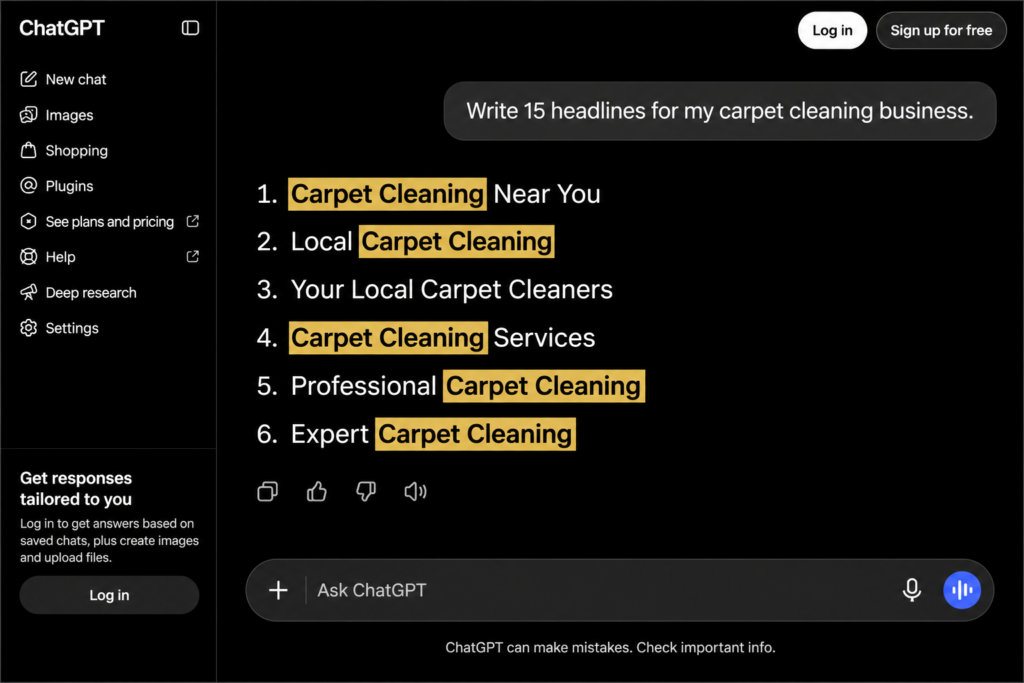
Illustrative ChatGPT example.
The 5-Part Responsive Search Ad Framework
Every Responsive Search Ad we build uses the five elements below across its 15 headline slots. Each headline needs to do at least one of these jobs.
1. Match the search intent
The first job of a headline is to look like the search. If someone types “carpet cleaner in Miami,” the strongest headline they can see is one that reads “Carpet Cleaning in Miami.” That match is also where you bake the keyword in, which helps the ad feel relevant to Google’s systems and to the person reading it.
The tighter your ad groups are themed around specific keywords, the easier this becomes. One theme per ad group, one intent match headline per theme.
2. State the USPs that make you different
A unique selling proposition is whatever this business does faster, better, or more completely than the competitors it is up against. If you do not know what yours are, run a short brand exercise before you touch the ad copy.
The reason this matters is simple. If you can plant a differentiator in your headlines that your competitors cannot copy, the ad stops looking like every other result. That is how an ad earns clicks in a crowded auction.
3. Add trust
Trust can be a risk reversal, like a money-back guarantee, or straight credibility, like an awards mention or a count of real reviews. People click ads from businesses they believe are not going to waste their time. One or two trust headlines is often the difference between a scroll and a click.
4. Make the offer and the CTA explicit
This is the one most people forget. We audit accounts regularly where a Responsive Search Ad has fifteen headlines, and not a single one asks the searcher to do anything.
For ecommerce, the CTA can be as simple as “Shop now” or “Free shipping over $50.” For lead generation, it is usually a form or a phone call: “Call today,” “Get a free quote,” “Talk to an expert in 5 minutes.” Pick the next step you want the searcher to take and say it out loud in the ad.
5. Test a theme on purpose
If you run two ads in an ad group, those two ads should test two different themes, not two slightly different headlines on the same theme.
One ad might be themed around speed to delivery. The other might be themed around price or discounting. The theme has to show up in the headlines themselves, not only in the copy you wrote on a whiteboard before you built the ads. That is how you learn which angle your customers actually respond to.
How to Split the 15 Headlines
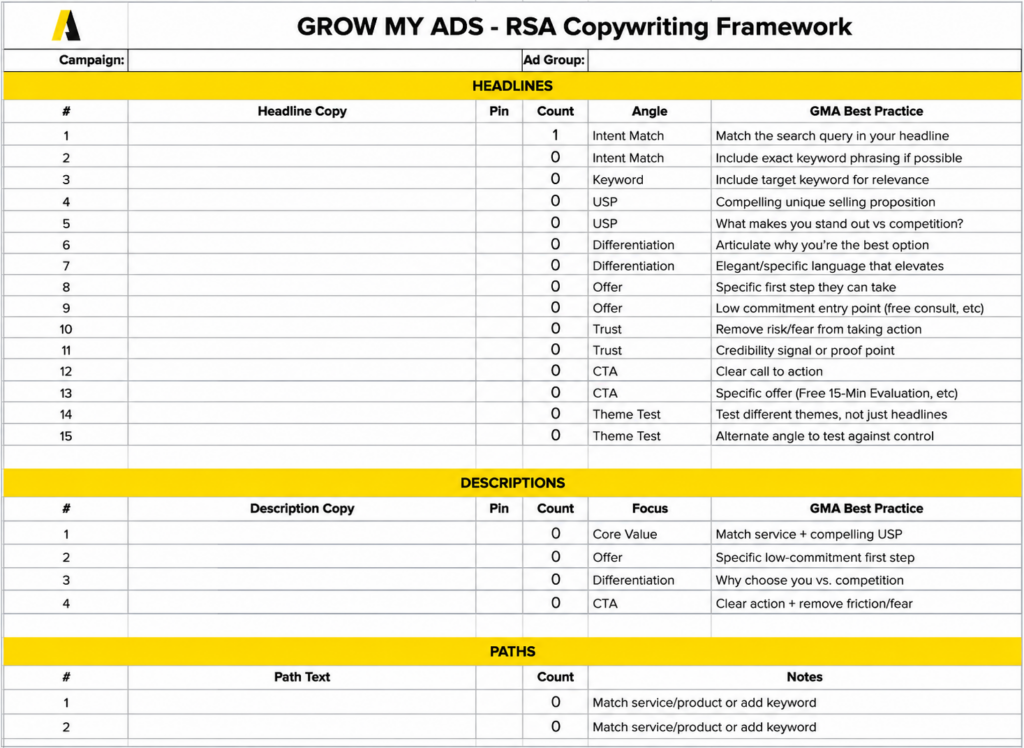
The framework turns into a build sheet. Here is how we split the 15 headline slots inside a Responsive Search Ad:
- Two intent match headlines that mirror the search
- One keyword headline for relevance
- Two USP headlines
- Two differentiation headlines
- Two offer headlines
- Two call-to-action headlines
- Two trust headlines
- Two theme test headlines, when you are running a theme test
The four description lines follow the same logic. One description leads with the service plus the strongest USP. One is offer-focused and low commitment. One is a differentiator. The last is a CTA that removes friction. When you look at the finished ad, every slot has a job.
The reason this works is that Google mixes the headlines in real time. If every slot is doing a different job, the combinations that get served to a searcher always include a reason to click. If every slot says the same thing, the combinations serve the same message five different ways and nothing stands out.
Three Ways to Use This Framework With AI
The framework works the same whether you write ads in a Google Sheet or feed it into an AI. The question is which AI setup fits how you work. Here are the three we use.
Option 1: The AI tool we built for the PPC Copilot community
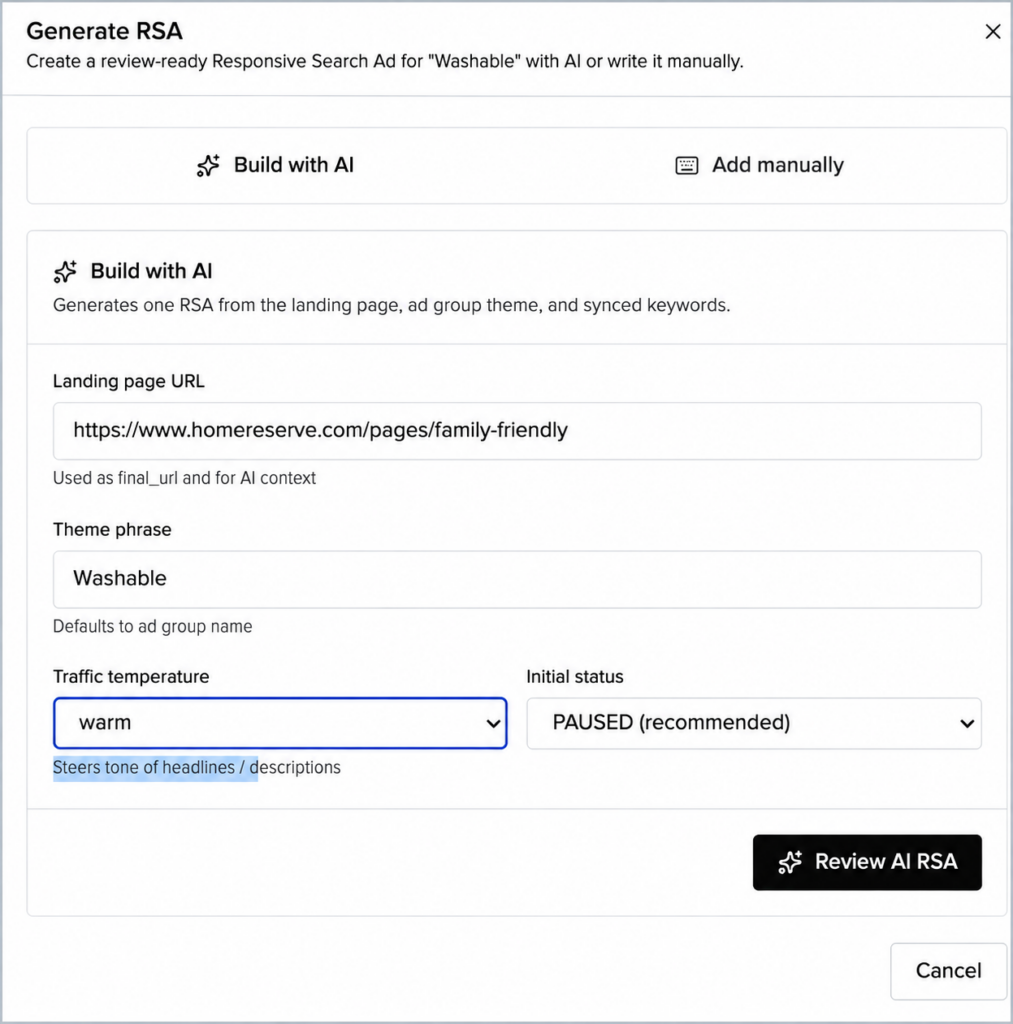
This is the one we use internally at Grow My Ads, and it is in beta for members of our PPC Copilot community. The tool is connected directly to the Google Ads account. Open an ad group, click “generate responsive search ad,” paste the landing page URL, and the tool pulls the page copy, applies the framework, and writes the full ad.
A 15-headline Responsive Search Ad builds in under a minute. We still polish the output before we push it live, because no AI output is perfect the first time. But the first draft is already better than most ads we audit, and we never have to leave the account or copy from a sheet into the clunky Google Ads interface.
Option 2: Claude Code or Claude Cowork with the GMA RSA Builder skill
For members who work in Claude Code or Claude Cowork, we built a skill called the GMA RSA Builder. The skill is the framework packaged as instructions Claude can follow automatically.
The prompt is almost nothing. You type “write an RSA for” and paste a URL. Claude recognises that the task needs the RSA Builder skill, loads it, pulls the landing page, and produces a framework-compliant ad with 15 headlines, four descriptions, and two paths, all inside the character limits. The output is ready to paste into the account.
Option 3: A prompt you can paste into ChatGPT or Claude today
If you are not inside the PPC Copilot community and you do not run Claude Code, you can still use the framework. The prompt version is a plain text prompt that encodes the same 5-part framework, the same headline split, the same character limits, and the same quality checks.
Paste it into a new ChatGPT or Claude conversation, fill in the keyword, landing page copy, offer, and proof points, and it produces a complete RSA using the same logic the tool and the skill use. It is slower than the tool, because you are doing the data entry yourself, but the output is the same framework.
The point is not which path you pick. The point is that all three paths feed the AI the same framework, and that is what produces ads that convert. The AI is doing the typing. The framework is doing the thinking.
What to Do Before You Trust an AI-Written Ad
Even with the framework, we do not push AI-written ads live without a quick polish pass. Four things to check every time:
- Character counts: Chat models miscount by a character or two sometimes, and Google will flag anything over the limit when you paste.
- Repeated words: If the same word shows up in more than three headlines, the ad is going to feel repetitive once Google starts mixing the slots.
- No made-up proof points: If your framework or prompt is doing its job, the AI will only use the guarantees, awards, and claims you gave it. Spot-check every trust headline against what the business actually offers.
- The CTA exists: Read the ad one more time and make sure at least one headline and one description tell the searcher what to do next.
That polish pass takes about two minutes per ad. It is the difference between an ad that is 70% of the way there and an ad you would be comfortable running on a client account.
FAQs: AI-Written Google Ads

Can AI really write Google Ads that convert?
Yes, when the AI is working from a framework. Generic prompts produce generic ads, and generic ads do not convert. The ads that convert hit the five parts of the framework in this guide: intent match, USPs, trust, offer plus CTA, and a theme test. Give an AI those instructions and the output is a serious ad.
Which AI is best for writing Google Ads copy?
The AI matters less than the inputs. We have tested Claude, ChatGPT, and Gemini on the same framework and the results are similar when the prompt, landing page, offer, and proof points are all provided. Pick the model you are already comfortable with and focus on the framework.
What is a Responsive Search Ad framework?
A Responsive Search Ad framework is a system for assigning each headline slot a specific job, so the finished ad covers intent, differentiation, offer, trust, and CTA instead of repeating the same message in every slot. Our framework splits the 15 headlines across those five categories, with four descriptions and two paths that follow the same logic.
Should I let AI write all of my Google Ads now?
AI can write the first draft, and in most cases it will be better than hand-written ads that skip the framework. We still polish every output before it goes live, mainly to catch character count issues, repeated words, and anything that invented a proof point we did not provide.
How do I test AI-written ads against human-written ads?
Use the same testing discipline you would for any Responsive Search Ad. Two ads per ad group, one control and one theme test, long enough to collect meaningful conversion data. Compare them by click-through rate first and by conversion rate once you have the volume. In our experience, framework-compliant AI ads hold up well against hand-written ones, and they take a fraction of the time to produce.
Final Thoughts
The headline most people repeat about AI in advertising is that AI writes bad copy. At Grow My Ads, that is not what we see. We see AI writing exactly what it is asked to write, and most people are not asking for very much.
Ask an AI to write 15 headlines for your business and you get 15 headlines for your business. Give an AI a framework that says these two headlines mirror the search, these two headlines name what you do better than the competition, these two headlines name the offer, these two headlines name the trust signal, these two headlines ask for the click, and the output is a different kind of ad.
It is not the AI. It is the framework.

If you want to use ours, you now have the whole thing. Pick whichever path fits how you work, and the first ad you build from it should already outperform the hand-written ads it replaces.
Get a personalized, 1-on-1 Google Ads account review
We offer a free account analysis for advertisers who qualify. It is a custom-tailored, in-depth review of your Google Ads account that reveals day-one improvements to your campaigns, the same kind of audit behind everything in this article.
We do not take every account that applies. We work with businesses where we are confident we can deliver real results, so we will need a few details on your business and goals before we book the call.
If that sounds like a fit, click below to apply.
